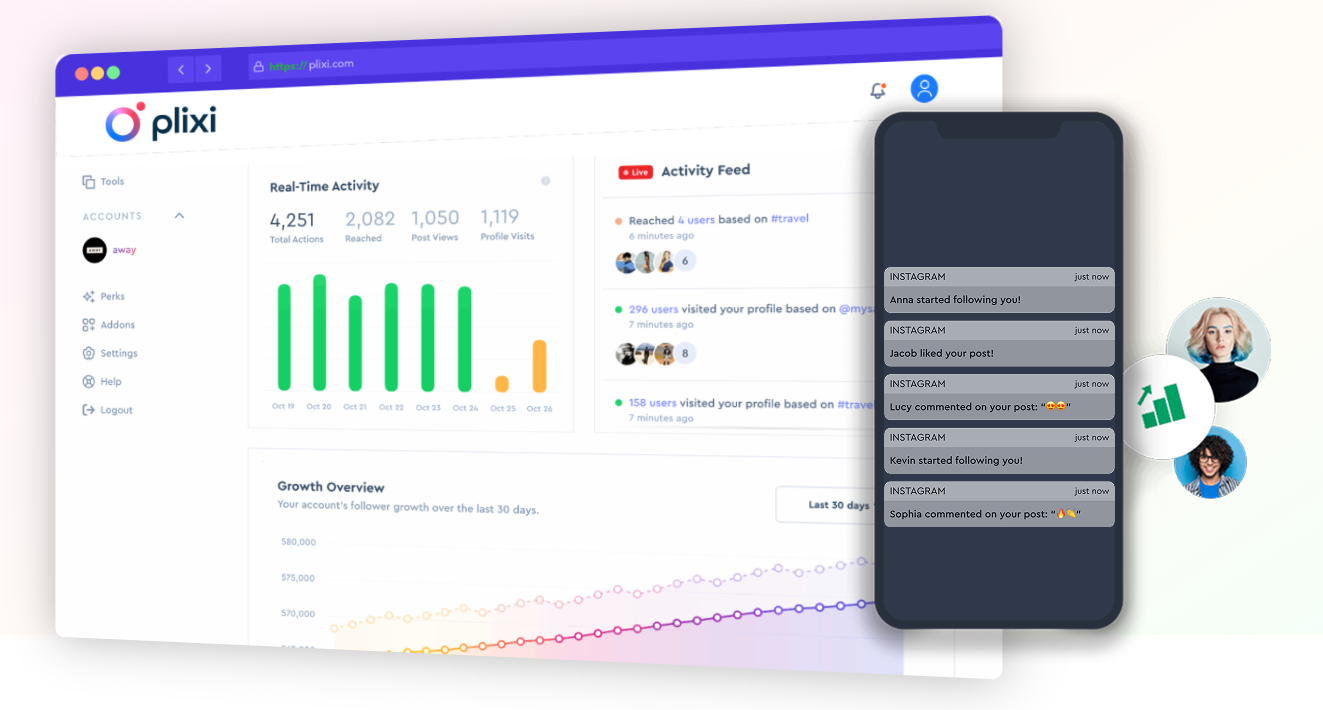


Agencies grow through momentum. One successful client leads to two more, then five, then a full portfolio. At that point, what used to feel manageable starts to strain the team. Manual outreach methods that worked for a few accounts become repetitive and time consuming across ten or more. Scaling turns into a scheduling problem rather than a creative one.
Plixi is positioned as an AI powered Instagram growth service focused on automated audience targeting. For SMM and digital agencies, the real value appears when growth becomes part of a structured workflow rather than a daily manual routine.
Creating a Repeatable Growth Framework for Every Client
Agencies need repeatable systems. Without structure, onboarding each new account feels like starting from scratch. Teams often rely on spreadsheets, manual follow cycles, and individual manager discipline to drive follower growth.
When reviewing options on this website, agencies typically focus on how automated targeting can be integrated into their onboarding process. Instead of assigning staff to repetitive engagement blocks, the team defines targeting parameters based on client niche and competitor research. Once configured, that layer operates continuously. Account managers shift from execution to supervision.
👋 Hey... Are you coming to our FREE Event: The 10X Your Freelancing Summit? Thousands are gathering virtually on August 25-27, 2026. Claim your FREE spot now.
For example, an agency managing three fashion brands can create separate targeting profiles aligned with each brand’s aesthetic and audience. One may focus on sustainable fashion communities, another on streetwear enthusiasts. The structure remains the same even though niches differ. This reduces the need for manual research cycles for every client.
Turning Setup into a Standard Operating Procedure
Scalable agencies document everything that is done. The targeting config being part of an onboarding checklist reduces variance between client accounts. The process begins with establishing the client’s positioning, competition analysis, determining target market audiences’ interests (this is done purposely), and lastly using an agency’s normal weekly and monthly report processes to create structured reports showing how targeting has grown with time. By doing this on a regular basis, it creates confidence with clients by providing a more organized way for clients to plan internally.
Redistributing Team Time Across Accounts
When client portfolios grow rapidly, many agencies experience an increase in junior employee time spent doing the same types of outreach. While these activities help to support growth, they also take away from the creation of a skilled workforce; therefore, senior employees are left to analyze results and communicate with clients. The introduction of automated targeting will change the amount of time spent on outreach through terminal repeats vs. focusing on job performance reviews and improving strategies. The type of work performed will be primarily analytical as opposed to mechanical, which over time will improve morale and develop groups of employees.
Managing Multiple Niches Without Fragmentation
Many businesses will be assisted by various agencies throughout their operations. Therefore, one group may support various sectors; at one time they may have businesses like gyms, local businesses or e-commerce businesses as clients. Having to conduct manual outreach takes a longer time and more research based on each type of client; thus, it is more complicated.
By utilizing Plixi’s structured targeting, each of these accounts has individualized parameters but the way the management is done stays fixed across the accounts. There are team members dedicated to monitoring activity, adjusting criteria, and reporting results under a require shared environment. The consistent manner in which these things are being handled helps decrease confusion within an organization; it will also decrease the amount of time needed to onboard new employees.
Improving Reporting Conversations
Clients expect clarity around results. Manual outreach methods can create fluctuations that are hard to explain. Automated targeting introduces measurable inputs that agencies can reference during reporting. Account managers discuss growth trends in relation to configured audience criteria. Adjustments become part of strategic discussion rather than reactive explanation. This shifts conversations from defensive to analytical.
Scaling Revenue Without Linear Headcount Growth
For many agencies, one of the most challenging realities is payroll pressure. Most likely due to increased demand from new clients requiring additional time, agencies generally need to increase headcount; therefore the more clients an agency has the more likely it is that the agency will continue to hire. Without structural efficiencies in place, the margins of an agency will continue to decrease as their book of business continues to grow.
Plixi eliminates the need to continually execute manually to grow followers. Agencies can now identify their target audience one time and then review their information at predetermined intervals. Because the acquisition layer continuously tracks the acquisition of new followers for an agency, it takes away the need for an agency to continually spend time on repetitive daily tasks to engage with their followers.
Agencies continue to focus on creating content and building a community; thus, they will continue to create marketing campaigns and build relationships. However, all the time spent on repetitive outreach to build followers will now be available for an agency to focus on creating strategic initiatives or acquiring new clients.
Over the course of multiple months, this change in how agencies conduct their business will have a positive effect on an agency’s profitability. Agencies will gain confidence in expanding their client base (taking on more accounts), as they will not be having their capacity to do so stretched in the same manner. Therefore, growth of an agency’s client base will be through systems and not through people.
A Practical Perspective on Sustainable Scaling
Scaling efficiently rarely depends on louder tactics. It depends on removing friction from daily operations. Plixi contributes by automating audience targeting while leaving creative direction and strategy in human hands.
For SMM and digital agencies, the benefit extends beyond follower counts. Teams operate within clearer processes. Reporting becomes more structured. Capacity planning feels more predictable.
The unusual takeaway is that efficiency in growth can protect creative quality. When repetitive tasks are reduced, teams focus more on positioning and storytelling. In competitive agency environments, that balance between structure and creativity often defines long term success.
Keep the conversation going...
Over 10,000 of us are having daily conversations over in our free Facebook group and we'd love to see you there. Join us!