


Agentic commerce is the quiet shift that decides which freelancers get hired a couple of years from now, and barely anyone is watching it. The gist is simple. Software has started doing the shopping itself. Not browsing on your behalf. Actually buying..
Nobody has bothered to write the freelancer version of this. So here it is. What agentic commerce actually means and why it hits your business in particular. Then the strategies to get ready, plus the mistakes that will catch you out.
What Is Agentic Commerce?
Quick grounding, then we get to the useful part.
Agentic commerce is online shopping where an AI agent does the buying instead of you. You say what you are after in natural language. The agent handles the product discovery. It lines the choices up against your budget and then completes the purchase.
👋 Hey... Are you coming to our FREE Event: The 10X Your Freelancing Summit? Thousands are gathering virtually on August 25-27, 2026. Claim your FREE spot now.
You still say yes or no. The agent just does the running around. The pick it brings back is closer to a personalized recommendation than a generic search result.
These are the same autonomous AI agents that already book a flight or reorder your coffee. Now they are learning to hire people and buy services. Which is the bit that should interest every freelancer reading this.
How Agentic Commerce Actually Works

A purchase runs through a handful of steps. The agent reads your request and searches across sales channels for a fit. It checks real-time availability and price. It picks one and runs the payment.
That last part only works because of new rules agents can follow. You will hear them called an agentic commerce protocol or an agent payments protocol. They are coming out of OpenAI, Stripe, and the card networks.
They are the framework that lets an agent pay a real merchant with real payment credentials and leave an audit trail behind each step. They also include fraud prevention and fraud detection, so an agent can’t be talked into a bad payment.
There is even an agent-to-agent protocol in the works, so your autonomous agent can talk to a merchant’s agent with no human intervention in between. Two AI assistants sorting out a deal while you nap.
Why Agentic Commerce Took Off In 2025 And 2026
Agentic commerce stopped being a demo and turned real for a few plain reasons. The AI models finally got good enough to run multi-step tasks without tripping over themselves. Payment providers built rails for agent-initiated transactions. And people enjoyed it, slightly to everyone’s surprise.
The adoption is already loud. Adobe found that 38% of US shoppers have used generative AI systems to shop online, and 52% plan to within the year. That isn’t a handful of nerds. That is a habit setting in across online shopping.

Why Freelancers Can’t Ignore Agentic Commerce

Fine, it is a trend. Why should you care when you have real clients to chase and rent to make? Three benefits of agentic commerce, and all of them are already moving.
1. Your Next Buyer Might Not Be Human
Companies are already sending agents out to find and vet suppliers, freelancers included. The thing reading your pitch could be an AI agent, ranking you against 10 rivals before a single person lays eyes on you. The decision-making is sliding toward agents, not just humans.
In business work, this is further along than most freelancers think. Gartner reckons that by 2028, roughly 90% of B2B buying will run through AI agents. That is over $15 trillion in agentic purchases. Sell to companies, and some of your future buyers are bots.
As AI agents acting on behalf of businesses become more common, freelancers will increasingly need to make their services easy for these systems to evaluate.
2. Agentic Commerce Changes How You Get Found
Ranking on page one mattered while a human did the scrolling. These intelligent agents don’t scroll. One asks a question in natural language. It then reads whatever is structured enough to make sense of and hands back a single answer.
Being the tenth blue link is worth very little when there are no blue links. The job shifts from being easy to find toward being easy for a machine to choose. There is a real change underway in how artificial intelligence is reshaping freelance work, and discovery is the leading edge of it.
3. Human-Only Work Gets More Valuable
The cheerful part of all this. Agents are great at comparing options and completing purchases. They are hopeless at taste, trust, and the judgment a real brief actually needs.
As routine buying gets handed to machines, the work that genuinely needs a person gets rarer and more expensive. That is the side of the fence you want to be on.
How To Get Your Freelance Business Ready For Agentic Commerce: 7 Proven Strategies

Right, the hands-on part. Seven strategies. Each one closes a different gap agentic commerce pries open. You don’t need all 7 done by Friday. You do need to begin.
1. Make Your Offer Something An Agentic Commerce Agent Can Instantly Understand
An agent can’t be won over by your charm or a slick logo. It reads what you offer and tries to line it up with what its human actually asked for. A hard-to-understand offer gives it nothing to match, so it moves on to someone it can read.
Being understandable beats being clever on the AI platforms doing the picking. The offers that get picked are the ones a machine can parse in one go and map onto a clear intent.
Supplements are a brutal test of this. Two products can look identical and do completely different things. A shopping agent asked to buy something for focus has to tell them apart from the data alone, not from vibes.

Nootropics Depot’s Lion’s Mane collection is a clean example of getting that right. It doesn’t dump one fuzzy listing on you. It splits the product by what you would actually want it for.
There is a concentrated 8:1 dual extract that is higher in ethanol-soluble compounds and built for cognitive support. A separate 1:1 full-spectrum extract is high in beta-glucans and aimed at immune health.
Each one explains what it is rich in and what it is for. And both mention in-house lab testing for purity and identity. Feed that to an agent, and it can match focus to the 8:1 and immune to the full-spectrum without a guess. That is structured product data doing the selling.
For your freelance offer, copy the logic rather than the molecules. Say plainly which of your packages suits a launch and which suits slow, steady growth. Name the job each one does. An agent pairing a brief to a provider should never have to infer which of your services fits.
How To Do It:
- State the exact outcome each of your packages delivers in one plain sentence
- Name the specific client type and problem each of your services targets
- Add structured data to your site so machines read your offer cleanly
- Cut the vague taglines that sound nice but tell an agent nothing
2. Get Into The Places Agentic Agents Actually Pull From
Talent plus invisibility is a losing hand here. Agents don’t roam your website hoping to be charmed. They pull from the structured sources they already trust. Marketplaces. Directories. Review platforms. The data from multiple system feeds all of them.
Miss those places, and you are not a candidate. Show up as a half-finished profile, and it is the same result. An agent can’t shortlist what it can’t see.
The reward for being visible is huge. McKinsey figures agentic commerce could move $3 trillion to $5 trillion in global retail spend by 2030. A freelancer visible to agents gets a cut of attention that used to take years of working on search to build. Work out where high-paying clients actually look for you, then make sure an agent can find you in those exact spots.
How To Do It:
- List every marketplace and directory your ideal clients or their agents search
- Fill out every profile field so your data reads complete and current
- Keep your services and availability updated across every platform you appear on
- Collect reviews on the platforms agentic AI agents read, not just your own site
3. Package A Service An AI Agent Can Actually Book
A lot of freelance offers end on a cliffhanger: contact me for a quote. A human might email anyway. An agent won’t bother. It wants a defined scope and a price it can read. Make buying you a negotiation, and the agent just books whoever kept it simple. The friction is what loses you the job, not the talent.
Services are where this gets hard. There is nothing to drop in a cart. Just an outcome and lots of unknowns. The reflex is to hide the price and promise a consultation. A patient human will play along. An agent sent to actually arrange the work hits a wall the moment there is no scope and no way in.
A good model for handling that comes from this commercial HVAC company. It says exactly what is on offer. System design and installation. Ductwork and air balancing. Building management programming. It names the towns it covers and flags 24/7 emergency response. It backs the work with NATE-certified technicians and a satisfaction guarantee.
Then it opens an actual door in. A Schedule online button. A service request form that collects the job details. It enables agents to read all of that and set the job moving without a phone call.

Your version doesn’t need ducts. Turn your core service into a fixed package with a visible price and a booking link. Say what is in and what is out. Do that, and an agent can act on you instead of stalling at a quote request you will answer three days late.
How To Do It:
- Turn your main service into a fixed-scope package with a clear price
- Add an instant booking link so a job can start without emails
- Spell out exactly what is included and what is not up front
- Publish a starting price instead of hiding every number behind a form
4. Sort Out How You Actually Get Paid In Agentic Commerce
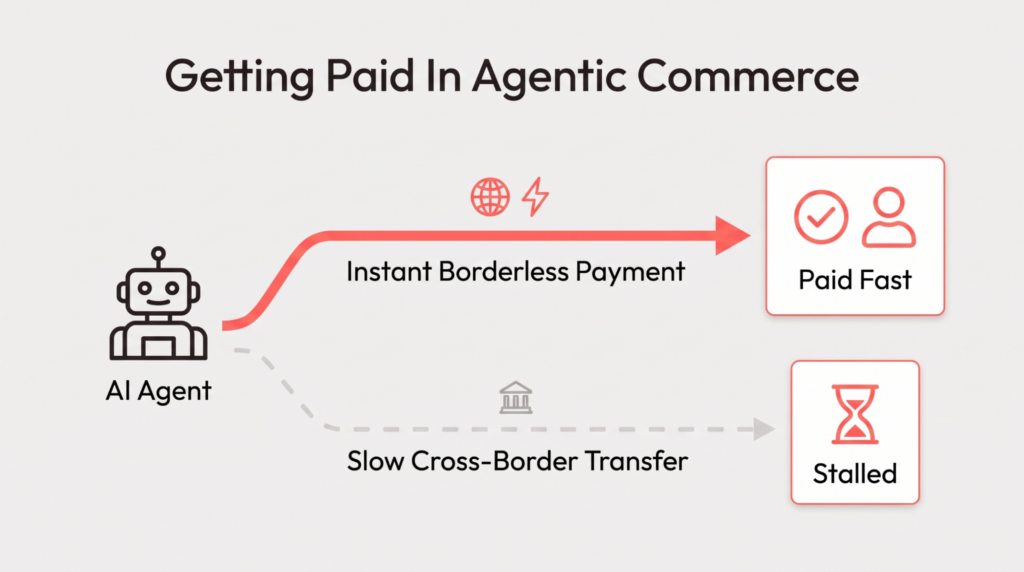
Getting chosen is only half the battle. The agent still has to pay you, and that is where plenty of freelancers come undone. Awkward invoicing. Bank transfers that take days. Payment methods that quit working at a border. Every one of those is friction an agent would rather skip. A simpler and more universal setup lets an agent complete the payment and move on faster.
The wall tends to show up the second your client or their agent is in another country. Cross-border money is still clumsy. Fees add up, and transfers crawl for days. Some methods flat-out refuse to work where your buyer happens to be. For anyone billing globally, each of those is a reason an agent-initiated transaction stalls at the very last step.
Oobit is one answer worth knowing about. It lets someone pay freelancers with crypto almost anywhere. It converts the crypto and runs it through an ordinary Tap-to-Pay card at the checkout, so the merchant side feels normal while the money underneath moves differently. The app is available for Android as Oobit crypto card on Google Play and for Apple devices as Oobit crypto card & payments on the App Store.
Two things make that useful for agent-driven payments. The money clears in near real time. And it ignores a bank’s opening hours, as well as whichever country you happen to be in. For a global freelancer, that is a way to take fast, borderless payments without asking a client to learn your local banking details.
The point isn’t crypto for the thrill of it. It is that an agent completing a payment needs rails that ignore geography, and the people who set those up get paid while everyone else waits on a wire.
How To Do It:
- Offer at least one instant preferred payment method clients can use anywhere
- Make your invoices readable and payable without a human chasing each one
- Remove any payment steps that tend to break when a client is overseas
- Keep fees and wait times low enough that paying you is effortless
5. Build For The Reorder, Not Just The First Sale
A one-off sale is the toughest thing to win in an agent world because you earn the pick from scratch every single time. Recurring work changes the maths. Once an agent has had a clean result with you, renewing becomes the lazy default. And agents adore a lazy default.
Build for repeat business, and the value compounds while everyone else keeps restarting the chase. The first sale gets you in the door. The renewals are where the money actually comes from.
Some things only make sense as a standing relationship, never a one-time buy. Anything built on health or upkeep works this way. The value isn’t the first order. It is in the steady delivery and the little course corrections over months. Treat that as a single sale, and you leave most of the money on the table, while handing yourself a fresh fight to be rechosen every cycle.
UpGuys runs its testosterone therapy exactly as that kind of ongoing program. What you buy isn’t a bottle; it is the care around it. You start with an online questionnaire and get lab work and a licensed practitioner’s review. You only pay once treatment is actually prescribed.
From there, it is recurring by design. The medication ships to your door. The plan folds in regular follow-ups. Ongoing lab testing. Dosage tweaks based on your actual results. The relationship is the product there, not any single order.
An agent keeps that sort of thing renewing happily, because the value shows up again every month. Your move is to turn your best work into a retainer or subscription an agent can re-up on a client’s behalf, instead of selling yourself cold every time.
How To Do It:
- Turn your best one-off service into a monthly retainer with clear deliverables
- Make renewing the automatic default unless a client actively chooses to stop
- Deliver a visible result early so the first cycle earns the second
- Build regular check-ins into the package so value keeps showing up monthly
6. Build The Proof An Agentic Commerce Agent Screens For
When an agent builds a shortlist, it looks for signals it can actually check. Ratings. Reviews it can read. A track record with numbers. Guarantees that take the risk off choosing you.
A human might gamble on a feeling or a pretty portfolio. An agent won’t. It is accountable to someone and wants choices it can defend. Thin proof looks risky, and risky gets filtered out before you ever get a look. Trusted agents give their humans safe picks, and safe means verifiable.
How To Do It:
- Gather reviews on third-party platforms an agent can read and verify
- Publish a short track record with real numbers and named client outcomes
- Offer a simple guarantee that visibly lowers the risk of choosing you
- Keep your proof current so it never looks neglected or badly outdated
7. Turn Agentic AI Commerce Into A Service You Sell
The opportunity tucked inside all this is honestly the best bit. Every business you work with has the same challenge coming, and almost none of them know where to begin. That is paid work with your name on it. Cleaning up a client’s customer data. Structuring their offers. Wiring in the AI tools that make their store readable to agents.
You get to be early to a skill barely anyone has, which is exactly where the good rates come from before the crowd arrives. And that is exactly why AI isn’t killing freelancing so much as reshuffling who does well.
How To Do It:
- Learn how agents read product data so you can fix clients’ listings
- Offer a packaged service that makes an existing client’s store fully agent-ready
- Add structured data and clean feeds for the clients you already have
- Position yourself now as the expert before this skill goes fully mainstream
3 Agentic Commerce Mistakes Freelancers Should Dodge

A few mistakes confuse people as they adjust to agentic commerce. These three turn up the most, and each one hurts in a different way.
1. Waiting Until AI Commerce Is Everywhere Before Doing Anything
The tempting move is to file this under someday and get back to paying work. The trouble is, the stuff that makes you legible to agents is slow to build. Reviews. Structured listings. A clean booking flow. A track record. None of it shows up overnight.
Start the week agents become your main buyer, and you are already a year behind the people who prepared while it was quiet. The cost isn’t missing a fad. It is gifting a head start to everyone who moved sooner.
How to Fix: Start small while the pressure is still low. Pick one strategy from the list above and finish it this month. Then take the next one. Think compounding interest, not a big launch day.
You don’t have to be fully agent-ready now. You only need to be further along than last month, so the shift speeds up with you riding it rather than chasing it.
2. Writing Everything For Humans And Nothing Agentic Commerce Can Parse
Your site reads like a dream. Clever headlines. A story-driven about page. Personality all over it. A human loves the thing. An agent gets nothing it can use.
The facts that matter are hidden. What do you do? Who is it for? What it costs? All of it wrapped in prose or trapped inside an image. So the agent skips you for a rival whose details are machine-readable. You lose the pick not for being worse, but for being unreadable.
How to Fix: Give the facts a plain home next to the personality. Keep the lovely writing. Just add a clear, structured version an agent can read too. A simple services list with names and prices. A specs block. Some structured data working in the background. The aim isn’t to kill the human voice. It is to make sure a machine can find the facts sitting underneath it.
3. Handing The Whole Relationship To Digital Commerce And Disappearing
Some freelancers hear all this and decide the goal is to automate themselves clean out of the picture. Let the agents run everything. The issue is that those customer relationships are still your real moat.
Clients who only ever meet your automated front door have no reason to stick around when something cheaper turns up. You have made yourself a commodity an agent can swap in seconds. The exact thing that made you hard to replace is now gone.
How to Fix: Let agents run the transaction while you keep the relationship. Automate the dull stuff. The booking. The billing. The reorders. Then show up as a human where it counts. In the work itself. In the judgment calls. The agent can be your front desk. It can’t be your whole personality.
Conclusion
Agentic commerce isn’t so much coming for freelancers as rearranging the field we all play on. The ones who struggle will be those who stayed invisible to machines and hoped the old way would hold. The ones who do well will have done the dull prep. Clear offers. Findable in the right spots. Easy to book. Easy to pay. Easy to rehire.
None of it is about out-teching the robots. It is about being the obvious, readable, and trustworthy choice when a machine is the one choosing.
That is the shift we think about non-stop at Millo. We help freelancers spot where the work is heading and adjust before it turns into a fire drill, so you stay booked and paid no matter who or what is doing the hiring. Get started now.
Keep the conversation going...
Over 10,000 of us are having daily conversations over in our free Facebook group and we'd love to see you there. Join us!