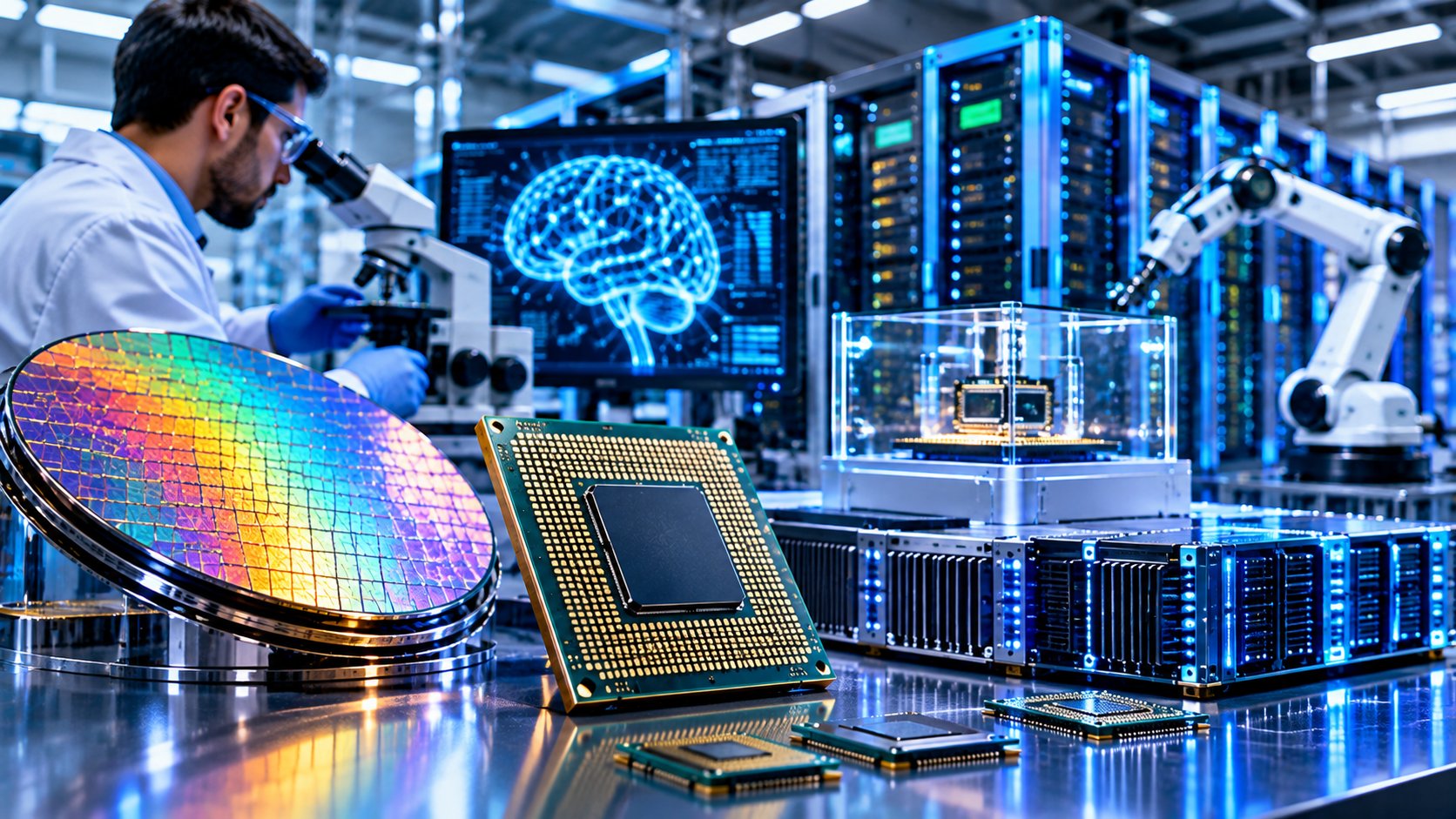


For the past few years, the dominant narrative in artificial intelligence investing has centered on sheer scale. Hyperscalers raced to construct sprawling data centers spanning hundreds of acres, packed with tens of thousands of graphics processors, and drawing enough electricity to power mid-sized cities. While that buildout drove historic gains across mainstream chipmakers, power grid bottlenecks and hardware limitations are forcing engineers—and institutional investors—to look at a quieter architectural shift.
Rather than simply building larger warehouses of general-purpose processors, federal laboratories and specialized chip designers are moving toward compact, high-precision computing nodes engineered specifically for scientific workloads. Understanding the technical divide behind this shift helps explain where the next wave of semiconductor capital expenditure is flowing.
The Hardware Bottleneck: FP16 Speed vs. FP64 Precision
Most commercial generative AI models—the systems powering everyday chatbots, image generators, and coding assistants—run on lower-precision floating-point formats such as FP16 or FP8. Floating-point precision determines how many decimal places a processor can track during mathematical calculations. Lower-precision math allows chips to process vast volumes of text and pixels quickly while keeping training costs manageable.
However, speed without decimal precision hits a hard wall in physical sciences. Lower-precision chips frequently struggle with exact arithmetic, which is why consumer chatbots still make basic counting mistakes or hallucinate citations. More importantly, those hardware constraints prevent standard commercial clusters from reliably modeling plasma behavior in nuclear fusion reactors, simulating molecular interactions for drug discovery, or stabilizing quantum computing qubits.
To solve this, national research facilities—including projects at Oak Ridge National Laboratory—are deploying dedicated “AI factories for science” built around FP64 (double-precision) hardware. Instead of massive single-site campuses that strain local utilities, these distributed micro-clusters pack high-precision accelerators into a fraction of the physical footprint and power draw, linking directly with existing Department of Energy supercomputing networks.
How Investors Track Early Supply Chain Beneficiaries
When government agencies and enterprise partners direct billions of dollars toward sovereign and scientific computing infrastructure, the financial impact extends well beyond mega-cap cloud providers. Several layers of the technology supply chain stand to benefit:
- High-Precision Chip Designers: Semiconductor firms producing specialized accelerators capable of balancing FP64 scientific accuracy with high-throughput AI workloads (such as AMD’s newer data center architectures) sit at the front of federal procurement pipelines.
- Thermal and Power Management Vendors: Even compact micro-clusters require advanced liquid cooling, high-density interconnects, and specialized power delivery components to sustain continuous scientific simulations.
- Small-Cap Contract Suppliers: Smaller publicly traded firms that secure component or integration contracts with national laboratories often experience sharper revenue inflection points than multi-trillion-dollar tech giants.
Market analysts who combine fundamental balance-sheet screening with quantitative momentum models often watch these early procurement cycles closely. For example, research breakdowns covering Marc Chaikin’s American Atlas Portfolio examine how quantitative rating systems track semiconductor leaders and smaller contract vendors tied to this next-generation supercluster buildout.
Practical Rules for Evaluating Niche AI Hardware Stocks
Because infrastructure themes attract heavy promotional coverage, individual investors need a disciplined filter before buying into smaller semiconductor or hardware names:
- Verify Confirmed Backlog Over Press Releases: Check quarterly earnings transcripts and Form 10-Q filings to confirm whether government or laboratory partnerships represent funded backlog rather than non-binding pilot agreements.
- Watch Gross Margins and R&D Burn: Designing high-precision silicon requires heavy upfront engineering spend. Compare research and development expenses against gross margin trends to ensure smaller vendors are not diluting shareholders just to keep prototypes running.
- Separate Sovereign Demand from Consumer Hype: Federal and scientific computing budgets operate on multi-year appropriations, making their revenue cycles distinct from consumer software spending.
Putting Infrastructure Research Into Context
Transitioning from general-purpose chatbots to scientific and industrial computing will not happen overnight, and hardware suppliers remain sensitive to broader semiconductor cyclicality. Investors evaluating these themes benefit from pairing technical industry reading with objective fundamental reviews. Exploring independent market analysis and educational stock breakdowns on platforms like Steady Income Investments can help retail investors weigh quantitative ratings, historical track records, and downside risks before committing capital to emerging tech sectors.
Keep the conversation going...
Over 10,000 of us are having daily conversations over in our free Facebook group and we'd love to see you there. Join us!

